C17200 Beryllium Copper Heat Treatment requires controlled temperature, accurate timing, and careful verification. This copper alloy combines high electrical conductivity with impressive strength after aging. Its performance, however, depends heavily on the treatment sequence. A small furnace error can change hardness, spring behavior, or dimensional stability.
This guide examines seven practical heat treatment methods used for C17200 components. These include solution annealing, precipitation hardening, direct aging, two-step aging, stress relieving, and process combinations. Each method serves a different manufacturing need. Some prioritize maximum hardness. Others protect conductivity or reduce distortion. The correct choice depends on the starting temper, component thickness, forming history, and final application.
Details matter here. A thin contact may heat quickly, while a thick connector can develop a temperature gradient. Furnace calibration, atmosphere control, loading density, and quenching practice all influence the result. Do not rely on nominal furnace settings alone. Measure the actual part response.
There is no universal schedule.
Reliable production also requires hardness checks, conductivity testing, dimensional inspection, and documented batch records. Experienced technicians compare results with supplier data and recognized material specifications. They also question unexpected results instead of forcing them to fit a chart. That caution is important, because C17200 responds differently after cold work, machining, or previous aging.
The seven methods below provide a practical framework, not a substitute for qualification trials. Test representative parts first. Recheck the process when geometry, equipment, or material source changes. That discipline supports safer decisions and more consistent performance.
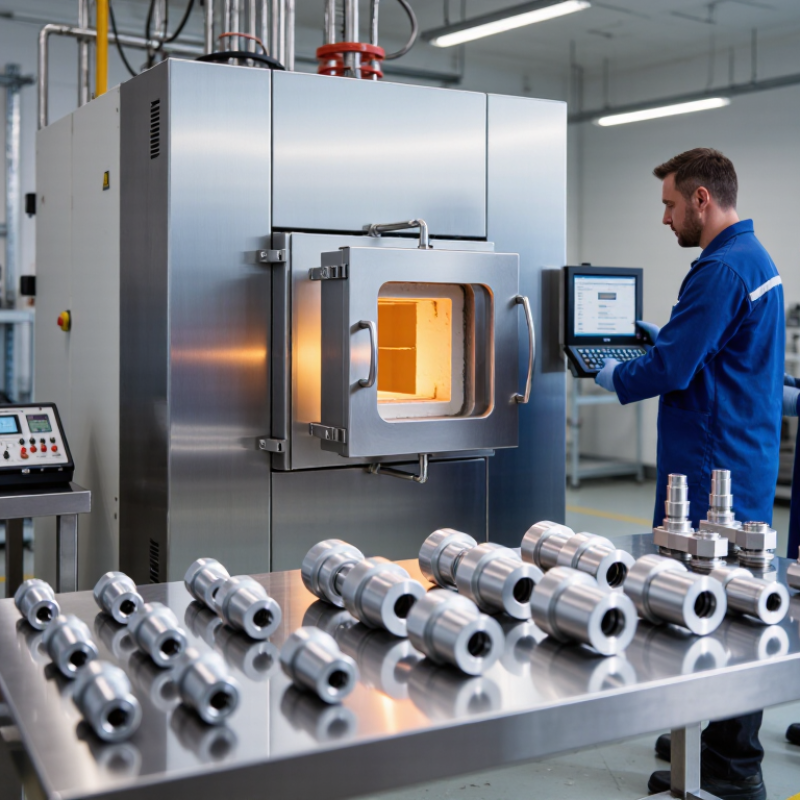
C17200 beryllium copper gains strength through precipitation hardening, not ordinary cooling alone. Its copper-rich matrix contains beryllium, which responds to controlled heating and aging. The material is usually solution treated around 760–800°C, then rapidly quenched. This creates a supersaturated structure for later precipitation. Quench quickly.
Heat treatment results depend on the starting condition. A solution-annealed route supports maximum age-hardening potential, while stress-relief annealing reduces distortion after machining. Direct aging may suit pre-hardened strip, but it cannot repair poor prior processing.
Cold work before aging can increase strength, although excessive deformation may reduce conductivity and dimensional stability. Common aging schedules use approximately 315–345°C for several hours, but exact time depends on thickness, temper, and furnace accuracy.
Clean surfaces matter. Oil, fingerprints, and furnace scale can produce uneven color or localized defects. Use calibrated thermocouples, stable airflow, and a verified quench system.
A thin contact section may cool quickly, while a heavy block retains heat and ages differently. This detail is often underestimated.
Overaging can lower hardness but improve ductility and dimensional stability. Underaging may leave useful conductivity, yet the final strength can be disappointing.
Testing hardness, electrical conductivity, and dimensions after treatment provides stronger evidence than temperature records alone. Small furnace variations can change results, so the selected schedule should be confirmed with the material certificate and a controlled trial.
Preparing C17200 Components Before Heat Treatment
C17200 beryllium copper needs careful preparation before any heat-treatment cycle. Remove oil, fingerprints, oxide, and machining residue with a solvent approved for industrial use. Even a thin contaminant layer can cause uneven color and local surface reactions. ASTM B194 and ASTM B196 identify C17200 as a precipitation-hardening copper alloy requiring controlled processing. The ASM Handbook, Volume 4, reports solution treatment near 760–790°C, depending on product condition and section size.
Inspect every component for sharp burrs, tool marks, and trapped coolant. Small defects can become stress concentrators during heating. Keep parts separated on clean, heat-resistant fixtures. Avoid contact with carbon steel, especially when surfaces are hot. Record alloy certificates, dimensions, starting hardness, furnace temperature, and loading pattern. These records support traceability and help explain unexpected hardness results. A second inspection is worth the time.
Tips: Use clean gloves. Measure the thickest section. Do not guess the soak time. Stabilize the furnace before loading parts, and verify temperature uniformity through a calibrated survey. Industry heat-treatment guidance from ASM emphasizes that component thickness and furnace control strongly affect precipitation response. In practice, preparation is sometimes rushed, and that is a weakness. A polished surface does not guarantee a successful treatment. Review the work instruction when distortion, discoloration, or hardness variation appears.
The chart shows typical temperature windows used when preparing and heat-treating C17200 beryllium copper components. Solution treatment is commonly performed around 760–800°C, while precipitation aging is commonly performed around 315–345°C. Stress relief may be carried out at approximately 260–315°C, depending on the component condition and required properties.
Before heating, remove oil, cutting fluid, and surface contamination; verify the alloy condition; use clean fixtures; avoid contact with dissimilar metals; and ensure uniform furnace temperature. Solution-treated components are normally quenched promptly, while the final cycle should be selected according to the applicable material specification, geometry, and required hardness.
For C17200 beryllium copper, solution annealing prepares the alloy for later age hardening. The goal is to dissolve strengthening phases into the copper matrix. A typical treatment uses approximately 760–800°C, but the exact temperature depends on product form, thickness, and supplier data.
Use a calibrated furnace with stable temperature control. Place parts on clean supports to reduce distortion and surface contamination. Hold long enough for uniform heating, not merely until the outside appears hot. Thin sections respond quickly. Heavy sections require more time. Small temperature errors matter.
Controlled quenching follows immediately after solution annealing. Water quenching is commonly selected because it limits premature precipitation. Transfer time should be short and consistent. Agitated water can improve cooling uniformity, but excessive turbulence may distort delicate parts. Record furnace temperature, soak time, transfer time, and quench conditions for each batch.
The process is not perfectly forgiving. A neat recipe can still fail. Warped parts, uneven hardness, or excessive grain growth may indicate poor thermal control. Check hardness after treatment, then confirm results through tensile or conductivity testing when required. Aging commonly follows solution treatment, often near 315–350°C, but the final schedule must match the material condition and required properties. Handle dust and machining residues carefully after treatment, using suitable industrial controls.
| No. | Heat Treatment Method | Typical Temperature | Typical Holding Time | Cooling Method | Primary Purpose | Important Process Considerations |
|---|---|---|---|---|---|---|
| 1 | Solution Annealing | 760–800 °C (1,400–1,472 °F) | Normally about 10–30 minutes after the material reaches temperature; thicker sections may require longer | Immediate rapid quench, usually water | Dissolves beryllium into the copper matrix and produces a supersaturated solid solution | Use a controlled furnace atmosphere when possible. Excessive temperature or time can increase grain growth and surface oxidation. |
| 2 | Controlled Water Quenching | Immediately after solution annealing | Transfer from furnace to quench tank with minimal delay | Agitated water, with adequate volume and temperature control | Retains the supersaturated structure required for later precipitation hardening | Delayed or uneven quenching may cause premature precipitation, lower aging response, and distortion. Fixtures may be required for thin or complex parts. |
| 3 | Polymer or Other Controlled Quenching | Immediately after solution annealing | Quench begins as soon as the load exits the furnace | Agitated polymer solution or another qualified rapid-quench medium | Reduces quench severity while maintaining a sufficiently supersaturated matrix | The concentration, temperature, agitation, and cooling curve must be validated. An excessively slow quench can reduce precipitation-hardening potential. |
| 4 | Standard Precipitation Aging | 315–345 °C (599–653 °F) | Approximately 2–4 hours, depending on section size and required properties | Air cool to room temperature after aging | Develops copper–beryllium precipitates and increases hardness, strength, and spring performance | Time and temperature must be tightly controlled. Overaging decreases strength and hardness but may improve ductility and dimensional stability. |
| 5 | Lower-Temperature Extended Aging | 260–315 °C (500–599 °F) | Several hours; the exact time depends on the target hardness and product form | Air cool | Provides a slower precipitation response and can support tighter control of distortion | Lower temperatures require longer cycles. Production trials are necessary because the peak-strength condition may take substantially more time. |
| 6 | Two-Step Aging | Typically 260–315 °C followed by 315–345 °C | A short first stage followed by a qualified second-stage aging cycle | Air cool between stages only when the procedure specifically requires it | Balances precipitation kinetics, strength, ductility, and dimensional stability | The sequence is alloy- and product-condition dependent. It should be qualified using hardness, tensile, conductivity, and dimensional checks. |
| 7 | Stress-Relief Treatment | Approximately 425–475 °C (797–887 °F) | About 1–2 hours, subject to part thickness and prior metallurgical condition | Controlled air cooling | Reduces residual stress after forming, machining, or straightening | This treatment can change hardness, conductivity, and precipitation condition. It should be applied before final aging when maximum age-hardened properties are required. |
Note: The temperatures and times shown are representative processing ranges for C17200 copper-beryllium and are not a substitute for the applicable material specification, product form requirements, furnace qualification, or controlled production trials.
C17200 beryllium copper gains strength through controlled precipitation aging after solution annealing and rapid quenching. Seven practical aging techniques can help adjust hardness, strength, conductivity, and dimensional stability. Single-stage aging uses one temperature and time, often near 315–345°C for several hours. Low-temperature aging takes longer but can improve process control. High-temperature aging shortens the cycle, although excessive exposure may reduce peak hardness. Always confirm the selected range against the material condition and furnace capability.
Two-step aging combines a lower-temperature hold with a hotter finishing stage. Interrupted aging pauses the cycle for inspection or forming, then resumes under controlled conditions. Underaging deliberately stops before peak hardness, leaving better ductility for later machining. Overaging uses additional time or heat to reduce hardness and improve stress relief. Small details matter. Load spacing, quench delay, surface cleanliness, and furnace uniformity can change the result. A verified thermocouple should measure the work-zone temperature, not merely the controller display. Test coupons should represent the production section thickness. Measure hardness and electrical conductivity together. Hardness alone can mislead. In practice, the strongest schedule is not always the best schedule. A minor timing error may create uneven properties across one batch. Record each cycle, inspect the fracture or machined surface, and revise cautiously when results disagree with expectations.
C17200 responds to seven practical routes: solution annealing, precipitation aging, direct aging, aging after cold work, stress relief, overaging, and combined thermo-mechanical treatment. The hardest result is not always the best result. Each route affects hardness, conductivity, springback, fatigue resistance, and dimensional stability. Use a test coupon matching the finished part’s thickness and forming history. Small differences matter. Record furnace temperature, holding time, quench delay, and aging atmosphere. A short delay can reduce repeatability.
Inspection must connect measurements with actual service requirements. Check Rockwell hardness at several locations, then verify tensile strength and electrical conductivity when required. Measure critical dimensions before and after aging, especially around thin walls, holes, and bends. Metallographic examination may reveal incomplete solution treatment, coarse particles, or excessive grain growth. Check discoloration and warpage. Hardness alone can mislead. A batch may meet the hardness target but fail dimensional inspection after machining. Acceptable on paper, unsuitable in practice.
Select the process by balancing strength, conductivity, fatigue life, and manufacturing risk. Complex formed parts may need solution treatment before final aging. Stable, cold-worked parts may need gentler stress relief. Compare at least three trial conditions. Do not trust one convenient setting. Use calibrated instruments and traceable records. “Aged as usual” is not a controlled instruction. Define acceptance limits before production, then challenge them with a second batch. Some results will remain inconvenient, but they often expose the real process weakness.
It dissolves strengthening phases into the copper matrix. This prepares the alloy for later age hardening.
A typical range is 760–800°C. The exact temperature depends on thickness, product form, and material data.
Use a calibrated furnace with stable temperature control. Clean supports can reduce distortion and surface contamination.
Hold parts until the entire section heats evenly. Thin parts respond quickly, while heavy sections need more time.
Rapid water quenching limits premature precipitation. Keep transfer time short and consistent.
Moderate agitation can improve cooling uniformity. Excessive turbulence may distort delicate parts.
Single-stage, low-temperature, high-temperature, two-step, interrupted, underaging, and overaging are practical options.
Not always. Underaging can retain ductility, while overaging can improve stress relief and dimensional stability.
Measure hardness and electrical conductivity together. Hardness alone can mislead.
Record furnace temperature, soak time, transfer time, quench conditions, and aging details. Small errors matter.
They may indicate poor thermal control, uneven loading, or inconsistent quenching. The neat recipe may still fail.
Use a verified thermocouple in the work zone. Test coupons should match the production section thickness. Reflection is necessary.
C17200 Beryllium Copper Heat Treatment is a controlled process used to improve the alloy’s strength, hardness, wear resistance, and dimensional stability while preserving its useful conductivity and toughness. This guide first explains the alloy’s response to heat and the principles behind precipitation hardening. It then covers essential preparation steps, including cleaning, inspection, stress reduction, fixture selection, and protection against contamination or distortion before heating.
The process continues with solution annealing and carefully controlled quenching to create a suitable metallurgical structure. Seven aging techniques are then discussed, showing how variations in temperature, holding time, staged heating, and cooling control can produce different balances of hardness, strength, conductivity, and stability. Finally, the article explains how to inspect treated components through dimensional checks, hardness testing, conductivity evaluation, and visual examination. By comparing these results with performance requirements, users can select a practical treatment method for different C17200 applications and maintain consistent quality.

Kepai