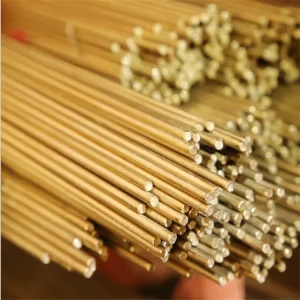
As a high performance copper based alloy, lead bronze performs well under heavy load and low speed.
1First, the material advantages of lead bronze
-
Excellent Self-Lubricating Properties
Lead particles form a lubricating film during friction, and the friction coefficient can be as low as 0.01-0.05, which significantly reduces the wear of moving parts.
-
Superior Load-Bearing Capacity
In terms of load-bearing capacity, lead bronze performs well. The allowable specific pressure can reach more than 25MPa, which fully meets the requirements of use under heavy load conditions.
-
Outstanding Corrosion Resistance
Lead bronze also has excellent corrosion resistance. It has good corrosion resistance in seawater, fresh water and other media to ensure the service life of the material.
2Technical parameters of lead bronze
-
Chemical Composition
Typical chemical compositions of lead bronze include: copper content of 60-80%, tin content of 5-10%, lead content of 5-25%. This precise composition ratio ensures the stability and consistency of material properties.
-
Physical Properties
In terms of physical properties, the density of lead bronze is 8.5-9.0g/cm³, the melting point is 850-950℃, and the coefficient of thermal expansion is 18.0×10⁻⁶/℃. These parameters determine its stability and reliability in high temperature environments.
-
Mechanical Performance
Mechanical performance parameters show that the tensile strength of lead bronze is more than 300MPa and the elongation is more than 10%, which ensures the safety and durability of the material during use.
3Application examples of lead bronze
-
Mining Machinery
In the field of mining machinery, lead bronze is widely used in the manufacture of ball mill bearings, crusher bushing and other key components. Its excellent wear resistance and self-lubricating properties ensure long-term stable operation of the equipment.
-
Metallurgical Equipment
In metallurgical equipment, lead bronze is used to manufacture important parts such as rolling mill bearings and continuous casting machine bearings. Its high load-bearing capacity and anti-fatigue performance provide a reliable guarantee for the safe operation of the equipment.
-
Construction Machinery
In the field of construction machinery, lead bronze is often used to manufacture key components such as excavator bearings and bulldozer bushings. Its impact resistance and wear resistance fully meet the strict requirements of construction machinery.
Lead bronze, with its excellent performance and wide range of applications, has become the ideal choice for heavy duty conditions. Choosing high-quality lead bronze products will provide you with reliable performance assurance for your equipment.
Frequently Asked Questions
What are the main advantages of lead bronze under heavy load conditions?
Lead bronze has excellent self-lubricating properties with a friction coefficient as low as 0.01-0.05, a high load-bearing capacity of over 25MPa, and outstanding corrosion resistance in seawater and freshwater.
What is the typical chemical composition of lead bronze?
Lead bronze typically consists of 60-80% copper, 5-10% tin, and 5-25% lead. This precise formulation ensures stable and consistent alloy characteristics.
What are the physical properties and thermal limits of lead bronze?
It features a density of 8.5-9.0g/cm³, a melting point range of 850-950℃, and a thermal expansion coefficient of 18.0×10⁻⁶/℃, allowing it to maintain dimensional stability in high temperature environments.
What is the mechanical strength of lead bronze materials?
Lead bronze features a tensile strength of more than 300MPa and an elongation rating of more than 10%, ensuring robust safety margins and mechanical durability during operation.
Which industrial machines commonly use lead bronze components?
Lead bronze is heavily utilized in mining machinery (crusher bushings, ball mills), metallurgical systems (rolling mills, casting machines), and construction equipment (excavator bearings, bulldozer bushings).
 Kepai
Kepai